Best paper for paper models: a card weight guide
Published
For most folded paper models, plain matt card of 160 to 220 gsm is the right choice: stiff enough to stand, thin enough to fold cleanly and light enough for a home printer. The exceptions are very small models, which need thinner card, and large ones, which need thicker. The tables below give the numbers.
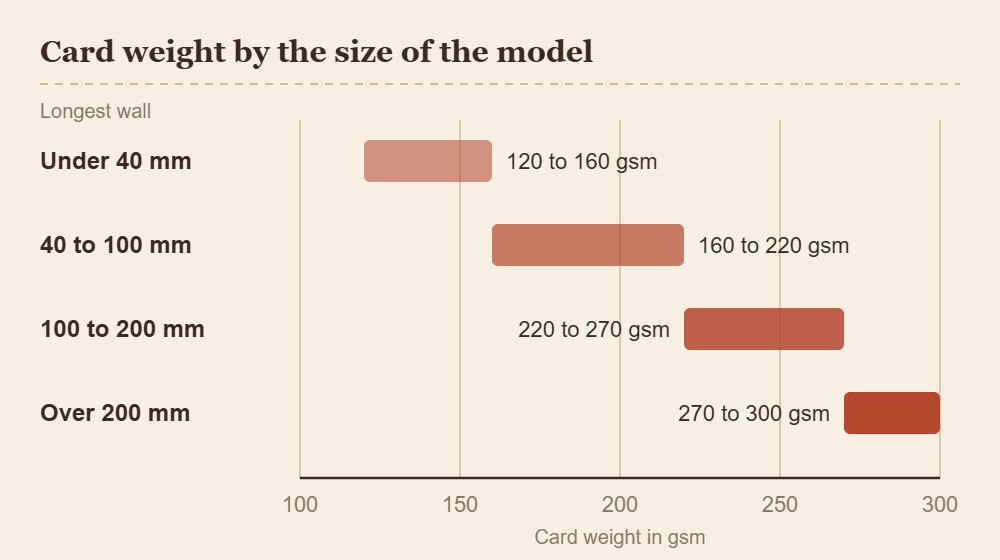
Pick the weight by the size of the model
| Longest wall | Card weight | Typical models |
|---|---|---|
| Under 40 mm | 120 to 160 gsm | Dollhouse accessories, 1:48 buildings, small geometric solids |
| 40 to 100 mm | 160 to 220 gsm | Paper houses, gift boxes, most one-page models |
| 100 to 200 mm | 220 to 270 gsm | Large boxes, lanterns, tall buildings |
| Over 200 mm | 270 to 300 gsm, or two glued layers | Display pieces, anything that carries weight |
The useful measure is the length of the longest unsupported wall, because that is the part that bows. A 30 mm wall in 160 gsm card is rigid. A 150 mm wall in the same card sags under its own roof.
Why heavier is not always better
Thick card resists folding. On a small model the folds are close together, and card over 220 gsm starts to round off at the corners instead of making a sharp edge. Glue tabs also get harder to hold down, because the stiff card springs back while the glue is still wet.
Thickness adds up as well. Card of 300 gsm is roughly 0.35 to 0.4 mm thick. Where a tab is glued inside a wall you have two layers, so a lid drawn to fit a box exactly can end up too tight. On models under about 50 mm, thinner card gives a more accurate result.
Gsm and lb are not the same scale
| US label | About, in gsm | Use for models |
|---|---|---|
| 20 lb bond (office paper) | 75 | Test prints only |
| 32 lb bond | 120 | Very small models |
| 90 lb index | 163 | Small to medium models |
| 65 lb cover | 176 | The usual choice in the US |
| 110 lb index | 199 | Medium models, boxes |
| 80 lb cover | 216 | Medium to large models |
| 100 lb cover | 270 | Large models |
| 110 lb cover | 298 | Large models, if your printer takes it |
Gsm is the weight of one square metre of the paper, so one number always means one thing. The pound figures used in the United States are the weight of a ream at a base sheet size, and the base size differs between kinds of paper. That is why 65 lb cover is a stiff card while 65 lb text is a thin sheet. When you buy by pounds, check that the pack says cover, index or cardstock.
Check what your printer can feed
Look up the maximum media weight in your printer manual before buying a pack. As a rough guide, many home inkjets take card up to somewhere between 200 and 300 gsm, and many home laser printers stop between 160 and 220 gsm. The limit is often lower for the main cassette than for the rear or manual tray, because the cassette bends the sheet round a tight roller.
- Use the rear or manual feed for card if the printer has one. The path is straighter.
- Set the paper type to card, heavy or thick paper. The printer then feeds more slowly and, on a laser, fuses the toner at a higher heat.
- Feed one sheet at a time if the printer picks up two.
- If the card is too heavy for the printer, print on ordinary paper and stick the print to card with a thin, even coat of glue stick or spray mount.
Matt, gloss or coloured
- Matt uncoated card is the easiest to work with. It takes glue quickly, folds without cracking and does not show fingerprints.
- Gloss and photo papers have a coating that cracks white along folds and that white glue does not grip well. Keep them for flat parts.
- Coloured card that is dyed all the way through hides the cut edges. Card that is only printed on the surface shows a white edge at every cut and fold.
- On a laser printer, large areas of toner can flake along a fold. Score the line first and the toner stays put.
Find the grain before you print
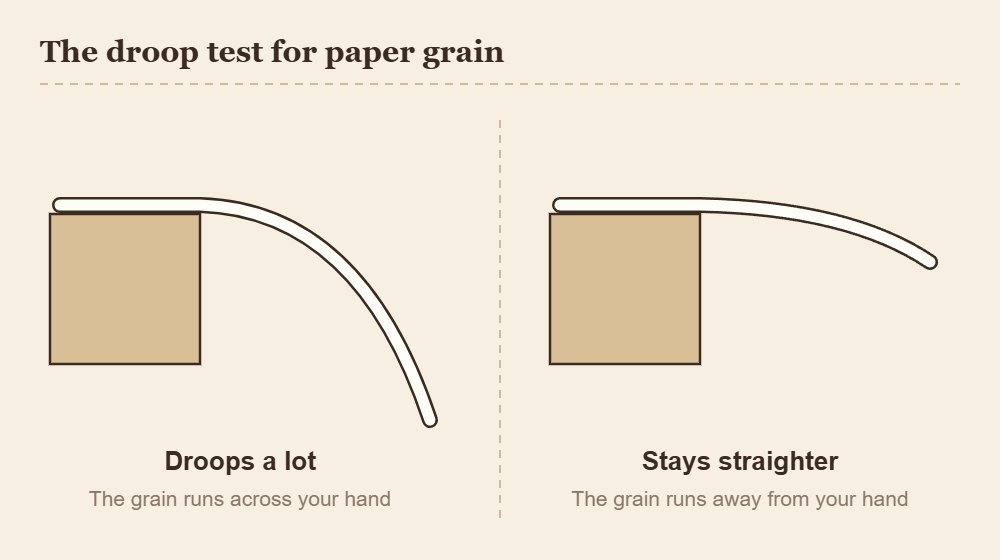
Machine-made paper has a grain: most of its fibres lie in one direction. A fold that runs along the grain is sharper and less likely to crack than one that runs across it.
To find it, hold a sheet by one edge and let it droop, then turn it a quarter and do the same. It droops further when the grain runs across your hand. Or bend the sheet gently into a curve each way: it resists less when the curve follows the grain.
You cannot line up every fold in a model. Line up the longest folds, or the ones on the most visible edges, by choosing portrait or landscape before you print.
If you only buy one pack
Buy white matt card of 160 to 180 gsm, which is 65 lb cover in the United States. Nearly every home printer feeds it, it suits models from about 30 to 120 mm, and it is sold everywhere. Add a pack of 220 to 250 gsm later if you start making larger boxes or buildings.
Whatever you choose, print one page first and measure the 50 mm bar on it before cutting. Card is thicker than office paper, and some printers scale the page slightly when the paper type changes.