How to score and fold cardstock without cracking
Published
To get a sharp fold in cardstock, press a groove along the fold line with a blunt point and a ruler before you fold, then fold so the groove ends up on the outside of the corner. That is the whole method. The rest of this page covers the details that decide whether the fold comes out crisp or cracked.
What scoring does
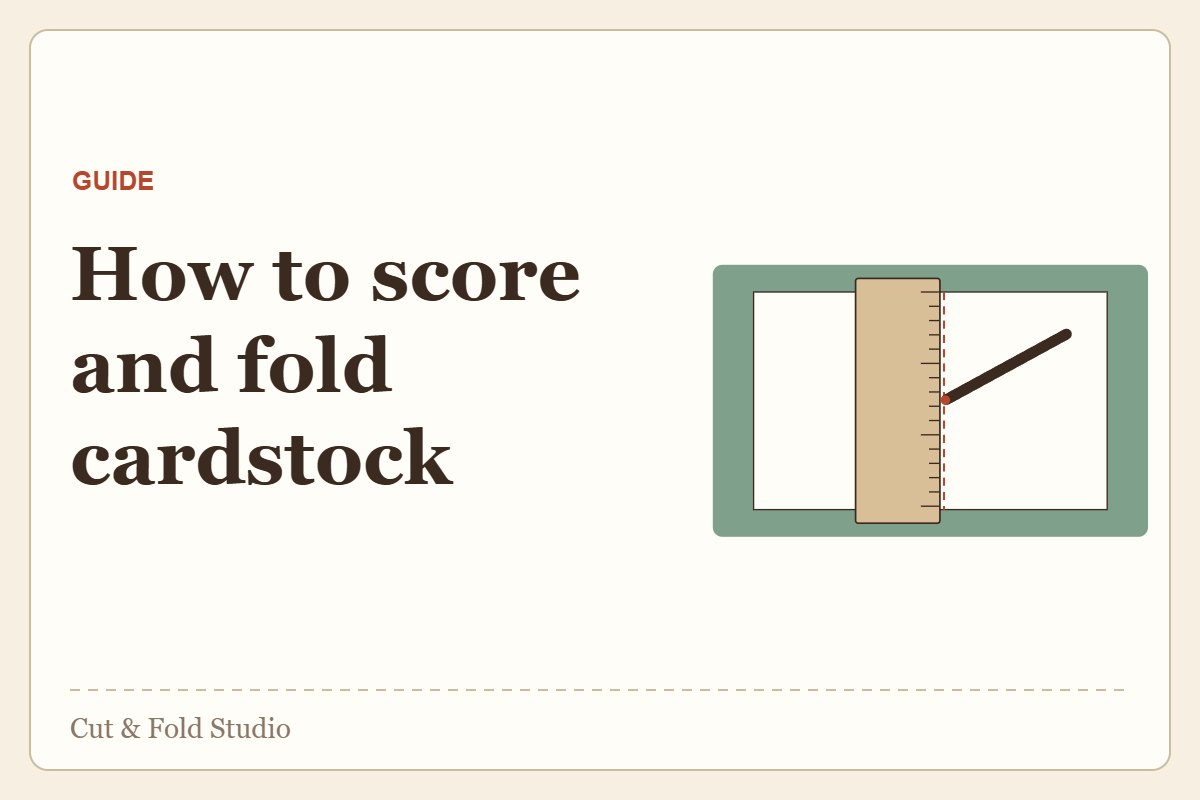
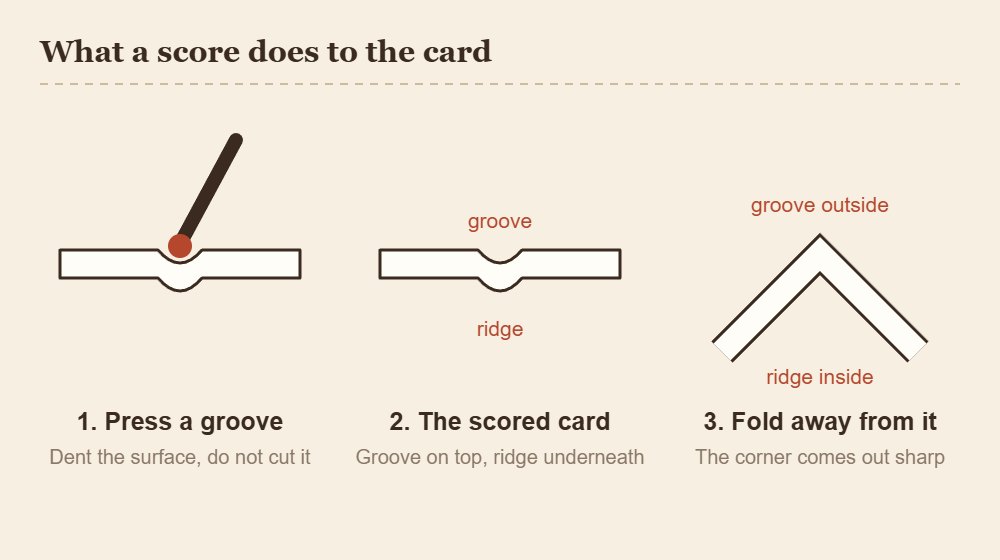
Card is a mat of fibres. Bend it without preparation and the fibres on the outside of the bend are stretched until some of them break, so the fold wanders and the surface cracks. A score is a narrow dent that crushes the fibres along one line. The card then bends exactly there, and with far less strain on the surface.
Scoring is not cutting. The surface should be dented, never broken. If you can see torn fibres or a cut in the groove, you pressed too hard or the tool is too sharp.
Tools that work
| Tool | Best for | Note |
|---|---|---|
| Empty ballpoint pen | Card up to about 220 gsm | Free, and the tip is the right size. Check it is fully dry on scrap first. |
| Embossing stylus | Small models and short folds | Comes with two ball sizes. Use the larger one on heavier card. |
| Bone folder | Long folds, heavier card | Use the pointed end against the ruler to score, and the flat side to press the fold. |
| Back of a table knife | Card over 250 gsm | Wide, so it makes the broader groove that thick card needs. |
| Scoring board | Many parallel folds | Fast for boxes and cards. Less use for the angled folds on models. |
You need something with a smooth, rounded point, a straight edge and a surface with a little give.
Step by step
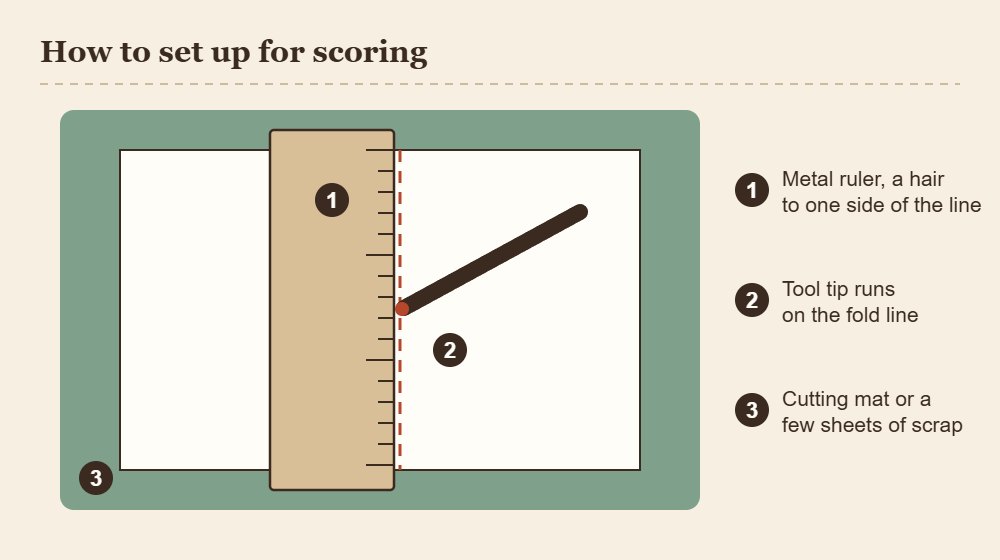
- Lay the sheet printed side up on a cutting mat, or on four or five sheets of scrap paper. A hard table gives the card nowhere to go and the tool just skids.
- Hold a metal ruler along the fold line. Set it a hair to one side, so the middle of the tool tip, not its edge, runs on the line.
- Draw the tool along the ruler with firm, even pressure. Two light passes are better than one heavy one.
- Score every fold line on the sheet before you cut the outline. A full sheet is much easier to hold still than a small cut-out part.
- Cut the part out, then fold each line away from you, so the groove is on the outside of the corner and the ridge it raised on the back sits inside.
- Run a fingernail or the flat of a bone folder along the fold to set it, then open it back to the angle the model needs.
On a printed template this works out neatly. You score along the printed lines and fold them all the same way, and the printed side ends up on the outside of the model.
Why folds crack, and how to stop it
- The fold runs across the grain. Paper folds cleanly along its grain and cracks across it. If the long folds of a model keep cracking, turn the page from portrait to landscape and print again.
- The card is coated. Gloss, photo and some smooth "premium" cards have a surface layer that splits. Use uncoated matt card for anything that folds.
- The score is too narrow for the card. Heavy card needs a wider groove. Move up from a pen tip to a bone folder or the back of a knife.
- One hard pass instead of several light ones. Heavy pressure tears the fibres that a gentle pass only bends.
- The card is very dry. In a heated room in winter, card loses moisture and turns brittle. Keep the pack flat in its wrapper, away from radiators and sunny windowsills.
- Printed colour across the fold. Laser toner sits on the surface and flakes when bent. A score before folding usually stops it; a dark solid colour may still show a pale line.
Card over 250 gsm: the half cut
Very thick card may not fold cleanly however well you score it. Model makers then use a half cut: one light stroke of a sharp craft knife along the fold line, on the side that will be the outside of the corner, cutting no more than a third of the way through. The card then folds away from the cut with a sharp edge.
A half cut weakens the fold, so use it only on thick card, and run a little glue along the inside of the corner once the model is assembled.
Scoring on a cutting machine
A cutting machine can make the fold lines for you, but it needs to know which lines to cut and which to score, so the file has to keep them apart. The "SVG for Cricut and Silhouette" download on every template page puts cut lines, score lines and drawn details in three separate groups for that reason.
On a Cricut, select the score group, change its operation from Cut to Score, then attach it to the cut group so the two stay in register. The machine scores with a scoring stylus or a scoring wheel; Cricut suggests the single wheel for ordinary card and the double wheel for coated or heavy card.
Most Silhouette machines have no scoring tool. The usual substitute is to set the score group to a dashed cut, which perforates the fold line so it bends in the right place.
Common questions
- Should I score before or after cutting? Before. The uncut sheet stays flat and still under the ruler.
- Do I need to score thin paper? Not below about 120 gsm. It folds cleanly along a ruler edge.
- Which way do I fold? Away from the scored side: groove outside, ridge inside. Folding towards the groove also works on thin card, but it cracks sooner on heavy card.
- Can I use scissors to score? Only the closed back of the blades, never the edge. A sharp edge cuts fibres instead of denting them.